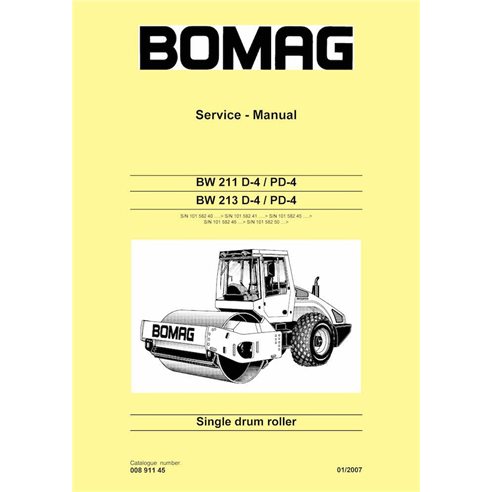
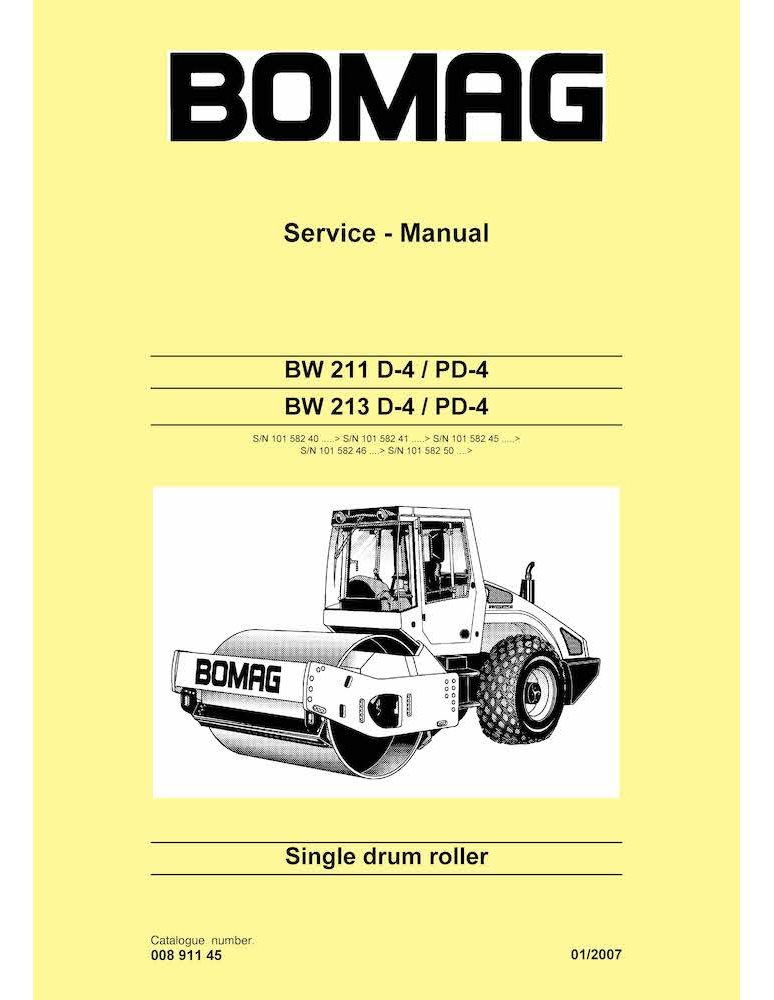
BOMAG-00891145-a07 BOMAG BW211, BW213 D-4, PD-4 single drum roller pdf service manual
English

BOMAG BW211, BW213 D-4, PD-4 single drum roller pdf service manual

BOMAG-00891145-a07
$34.90
No tax

Format: PDF

Pages: 1026

File size: 88.86 MB

Language: English

Models: BW211 D-4, PD-4 BW213 D-4, PD-4 single drum rollers, S/N 101 582 40 .....> S/N 101 582 41 .....> S/N 101 582 45 .....> S/N 101 582 46 ....> S/N 101 582 50 ....>

BOMAG-00891145-a07-EN-preview.pd - 1.92MB
Log in to access your free preview PDF

Try Before You Buy
Sign in or create a quick account in seconds to download a free preview PDF file, where you find "Bookmarks" tab to see the complete table of contents. Review the manual's layout, detail, and quality to ensure it’s exactly what you need.

Create an account and join to our cumulative discounts program. Spend at least $29.9 and get 10.00% discount.
 

Table of Contents for BOMAG-00891145-a07-EN manual

  • BW 211 D-4 / PD-4
  • BW 213 D-4 / PD-4
    • S/N 101 582 40 .....> S/N 101 582 41 .....> S/N 101 582 45 .....>
    • S/N 101 582 46 ....> S/N 101 582 50 ....>
  • Single drum roller
    • 1 General
  • 1.1 Introduction
  • Safety regulations
    • Important notes
    • General
    • Precautions and codes of conduct for welding work
    • Old oils
    • Hydraulics
    • Fuels
    • Hot fuels
    • Synthetic rubber
    • Poisonous substances
    • Air conditioning system
    • Battery
    • Special safety regulations
  • General repair instructions
    • General
    • Electrics
    • Battery
    • Hydraulic system
    • Air conditioning system
    • Fuel hoses
    • Gaskets and mating surfaces
    • Feather keys and keyways
    • Ball and roller bearings
    • Screws and nuts
  • Tightening torques
    • 2 Technical data
  • Technische Daten
    • Fig. 10
    • Fig. 11
  • 2.2 Maintenance chart
  • 2.3 Table of fuels and lubricants
  • 2.4 Fuels and lubricants
    • Engine oil
    • Fuels
    • Coolant, anti-freeze agent
    • Hydraulic oil
    • Oil for drive axle
    • Lubrication grease
  • 4.1 Special tools, tests and adjustments
    • Fig. 1
    • Fig. 2
    • Fig. 3
    • Fig. 4
    • Fig. 5
    • Fig. 6
    • Fig. 7
    • Fig. 8
    • Fig. 9
    • Fig. 10
    • Fig. 11
    • Fig. 12
    • Fig. 13
    • Fig. 14
  • 4.2 Checking the rotation speeds
    • Fig. 1
    • Check the engine speed
    • Checking the exciter shaft speed
  • 4.3 Checking / adjusting the neutral positions of the travel pump
    • Fig. 1
    • Fig. 2
    • Fig. 3
    • Fig. 4
    • Fig. 5
    • Fig. 6
    • Fig. 7
  • 4.4 Pressure tests in the travel circuit
    • Fig. 1
    • Fig. 2
    • Fig. 3
    • Fig. 4
  • 4.5 Checking / adjusting the vibrator shaft speeds
    • Fig. 1
    • Fig. 2
    • Fig. 3
  • 4.6 Pressure measurements in the vibration circuit
    • Fig. 1
    • Fig. 2
  • 4.7 Check the leakage rate of the vibration motor
    • Fig. 1
    • Fig. 2
    • Fig. 3
  • 4.8 Pressure test in steering circuit
    • Fig. 1
    • Fig. 2
    • Fig. 3
    • Fig. 4
    • Fig. 5
  • 5.1 Special tools for flushing
    • Fig. 1
    • Fig. 2
    • Fig. 3
    • Fig. 4
    • Fig. 5
    • Fig. 6
    • Fig. 7
    • Fig. 8
    • Fig. 9
    • Fig. 10
    • Fig. 11
    • Fig. 12
    • Fig. 13
    • Fig. 14
    • Fig. 15
    • Fig. 16
    • Fig. 17
    • Fig. 18
    • Fig. 19
  • 5.2 Flushing - general
    • Changing a component
    • Chips (abrasion) in the oil
    • Before flushing
    • Bleeding
    • Servicing the flushing filter kit
  • Flushing schematic travel circuit (distribution travel pump)
    • 1 Elbow union (tool)
    • 2 Connecting union (tool)
    • 3 Drum drive motor
    • 4 Axle motor
    • 5 Screw socket R1 - 25S (tool)
    • 6 Flushing hose 25S - 20S (tool)
    • 7 Flushing hose 25S - 20S (tool)
    • 8 Flushing filter with filter element 1m (tool)
    • 9 Elbow union (tool)
    • 10 Reducing fitting (tool)
    • 11 Travel pump
    • 12 High pressure hose (B, drum drive motor reverse)
    • 13 High pressure hose (A, drum drive motor forward)
    • 14 High pressure hose (B, axle motor reverse)
    • 15 High pressure hose (A, axle motor forward)
    • 16 High pressure hose (B, axle motor reverse)
    • 17 High pressure port (B, drum drive motor reverse)
    • 18 Flushing hose 25S - 20S (tool)
    • 19 Flushing hose 25S - 20S (tool)
  • 5.4 Flushing the travel circuit (travel pump distribution)
    • Flushing the drum drive
    • Flushing the axle drive
  • Flushing schematic travel circuit (distribution axle motor)
    • 1 Elbow union (tool)
    • 2 Connecting union (tool)
    • 3 Drum drive motor
    • 4 Axle motor
    • 5 Screw socket R1 - 25S (tool)
    • 6 not used
    • 7 not used
    • 8 Flushing filter with filter element 1m (tool)
    • 9 not used
    • 10 Reducing fitting (tool)
    • 11 Travel pump
    • 12 High pressure hose (drum drive motor reverse)
    • 13 High pressure hose (drum drive motor forward)
    • 14 High pressure hose (B, axle motor reverse)
    • 15 High pressure hose (A, axle motor forward)
    • 16 High pressure hose (B, axle motor reverse)
    • 17 not used
    • 18 Flushing hose 25S - 20S (tool)
    • 19 Flushing hose 25S - 20S (tool)
  • 5.6 Flushing the travel circuit (axle motor distribution)
    • Flushing the drum drive
    • Flushing the axle motor
  • Flushing schematic for vibration drive
    • 1 Elbow union (tool)
    • 2 Connecting union (tool)
    • 3 Vibration motor
    • 4 Vibration pump
    • 5 Screw socket R1 - 25S (tool)
    • 6 Flushing hose 25S - 20S (tool)
    • 7 Flushing hose 25S - 20S (tool)
    • 8 Flushing filter with filter element 1m (tool)
    • 9 SAE flange (tool)
    • 10 High pressure hose (B, high frequency)
    • 11 High pressure hose (A, low frequency)
  • 5.8 Flushing the vibration circuit
    • Fig. 1
    • Fig. 2
    • Fig. 3
    • Fig. 4
    • Fig. 5
    • Fig. 6
    • Fig. 7
    • Fig. 8
    • Fig. 9
    • Fig. 10
  • 5.9 Bleeding the travel circuit
    • 1. Install a pressure test hose to the charge pressure test port.
    • 2. Install a pressure test hose each to the high pressure test ports.
    • Fig. 1
    • Fig. 2
    • Fig. 3
    • Fig. 4
    • Fig. 5
  • 5.10 Bleeding the vibration circuit
    • 1. Install a pressure test hose to the charge pressure test port.
    • 2. Install a pressure test hose each to the high pressure test ports.
    • Fig. 1
    • Fig. 2
    • Fig. 3
    • Fig. 4
    • Fig. 5
    • 6.1 Understanding circuit diagrams
    • 6.2 Terminal designations
    • 6.3 Current and voltage
    • 6.4 Resistance
    • 6.5 Series / parallel connection
    • 6.6 Ohm's law
    • 6.7 Electrical energy
    • 6.8 Formula diagram
    • 6.9 Metrology
    • 6.10 Diodes, relays, fuses
    • 6.11 Batteries
    • 6.12 Three-phase generator
    • 6.13 Electric starter
    • 6.14 Telemecanique switch
    • 6.15 Inductive proximity switches
    • 6.16 Angle sensor with current output
    • 6.17 Plug connectors
    • 6.18 Deutsch plug, series DT and DTM
    • 6.19 Plugs and terminals in spring clamping technology
  • 7.1 Special tools, electrics
    • Fig. 4
    • Fig. 5
    • Fig. 6
    • Fig. 7
    • Fig. 8
    • Fig. 9
    • Fig. 10
    • Fig. 11
    • Fig. 12
    • Fig. 13
    • Fig. 14
    • Fig. 15
    • Fig. 16
    • Fig. 17
    • Fig. 18
    • Fig. 19
    • Fig. 20
    • Fig. 21
    • Fig. 22
    • Fig. 23
    • Fig. 24
    • Fig. 25
    • Fig. 26
    • Fig. 27
    • Fig. 28
    • Fig. 29
    • Fig. 30
    • Fig. 31
    • Fig. 32
    • Fig. 33
    • Fig. 34
    • Fig. 35
    • Fig. 36
  • 8.1 Seat contact module
    • 9 Speedometer Module
  • 9.1 Speedometer module
    • Fig. 1 Speedometer module
  • 10.1 Electrics BEM (BOMAG Evib-meter)
    • BOMAG Evib-meter (BEM)
  • 10.2 Service Training
    • 11 Engine
  • 11.1 Diesel engine, general
    • Fig. 1 Engine compartment
  • 11.2 Service side
    • Fig. 1 Service side
  • 11.3 Starter side
    • Fig. 1 Starter side
  • 11.4 Lubrication oil circuit
    • Fig. 1 Lubrication oil circuit
  • 11.5 Oil pressure switch and low oil pressure circuitry
    • Fig. 1
    • Fig. 2 Oil pressure switch
  • 11.6 Check the engine oil level
    • Fig. 3
  • 11.7 Changing engine oil and oil filter cartridges
    • Fig. 4
    • Fig. 5
    • Fig. 6
    • Fig. 7
  • 11.8 Coolant circuit
    • Fig. 1 Coolant circuit
    • Fig. 2 Coolant filling level sensor B55
    • Fig. 3 Direct heating
  • 11.9 Coolant temperature switch
    • Fig. 1 Coolant temperature switch
  • 11.10 Disassembling and assembling the coolant temperature switch
    • Fig. 2 Temperature switch
    • Fig. 3 Coolant temperature switch
  • 11.11 Replacing the thermostat
    • Fig. 4
    • Fig. 5
    • Fig. 6
  • 11.12 Checking the thermostat in disassembled state
    • Fig. 1
    • Fig. 2
    • Fig. 3
  • 11.13 Check the coolant level
    • Fig. 4
  • 11.14 Change the coolant
    • Fig. 5
    • Fig. 6
    • Fig. 7
  • 11.15 Clean the cooling fins on engine and hydraulic oil cooler
    • Cleaning with compressed air
    • Cleaning with cold cleansing agent
  • 11.16 Three-phase generator
    • Fig. 1
  • 11.17 Fuel supply
    • Fig. 1 Fuel supply
    • Fig. 1
    • Fig. 2 Observe the direction of flow
  • 11.18 Injection system
    • Single cylinder plug-in injection pumps
  • 11.19 Injection pump replacement during service
    • Disassembly
  • 11.20 Injection valve replacement during service
    • Removal
    • Installation
  • 11.21 Checking / repairing injection valves
    • Check the injection valves
    • Adjusting tze opening pressure on the injection valve
    • Leak test
    • Rattle and spray pattern test
  • 11.22 Fuel filter
    • Fig. 1 Fuel pre-filter
    • Function
    • Fuel pre-heating (option)
    • Draining off water or fuel
    • Perform
    • Main fuel filter
  • 11.23 Check, clean the water separator
    • Fig. 3
  • 11.24 Change the fuel pre-filter cartridge
    • Fig. 4
    • Fig. 5
    • Fig. 6
    • Fig. 7
  • 11.25 Change the fuel filter cartridge
    • Fig. 8
    • Fig. 9
  • 11.26 Checking the compression
    • Fig. 1
    • Fig. 2
    • Fig. 3
    • Fig. 4
  • 11.27 Check, adjust the valve clearance
    • Valve adjustment schematic
    • Checking the valve clearance
    • Adjusting the valve clearance
  • 11.28 Boost fuel solenoid valve
    • Fig. 1
  • 11.29 Engine shut-down solenoid
    • Fig. 1
  • 11.30 Air filter, differential pressure switch
    • Fig. 1
  • 11.31 Service the combustion air filter
    • Fig. 2
    • Fig. 3
    • Removing the main filter element
    • Cleaning the main filter element
    • Cleaning the dust bowl
    • Installing the main filter element
    • Changing the safety filter element
  • 11.32 Heating flange on engine
    • Fig. 1 Heating flange
    • Fig. 2 Heating flange (R19) with hose socket BF4M 2012 C
    • Fig. 3
    • Fig. 4 Coolant temperature sensor
    • Fig. 5 Heating flange function diagram
  • 11.33 Checking the heating flange control
    • Fig. 1 Monitoring board (A15)
  • 11.34 Electric throttle control
    • Fig. 1 Engine solenoid
    • Fig. 2 Throttle control switch
    • Fig. 3 Electric circuit of solenoid
    • Fig. 4
    • Fig. 5
  • 11.35 Engine monitoring
    • Fig. 1
    • Fig. 2 Differential pressure switch
    • Fig. 3 Sensor water separator
    • Fig. 4 Oil pressure switch
    • Fig. 5 Coolant temperature switch
    • Fig. 6 Coolant temperature switch
    • Fig. 7 Emergency stop switch
  • 11.36 Engine
  • 11.37 Special tools, Deutz engine (BFM 2012)
    • 12 Air conditioning system
  • 12.1 Physical basics
    • Fig. 1
    • Fig. 2
    • Pressure and boiling point
  • 12.2 Refrigerant R134a
    • Environmental aspects
  • 12.3 Compressor oil / refrigeration oil
  • 12.4 Working principle of the air conditioning system
    • Fig. 1 Principle sketch of an air conditioning system
  • 12.5 Monitoring devices
    • Fig. 2 Monitoring chain consisting of:
  • 12.6 Description of components
    • Compressor
    • Condenser
    • Dryer / filter / fluid container / inspection glass
    • Expansion valve
    • Evaporator
    • Defroster thermostat
    • Pressure switch
    • Pipes and hoses
  • 12.7 Checking the compressor oil level
    • Checking the compressor oil level / refrigeration oil level
  • 12.8 Checking the magnetic clutch
    • Fig. 1
    • Fig. 2 Measuring the air gap
    • Cross-section of magnetic clutch
  • 12.9 Inspection and maintenance work
  • 12.10 Checking, replacing the refrigerant compressor V-belt
    • Check the V-belt
    • Tighten the V-belt.
    • Changing the V-belt
  • 12.11 Service the air conditioning
    • Cleaning the condenser
    • Checking the refrigerant level
    • Checking the moisture level of the drying agent
    • Checking the condition of the drier/collector unit
  • 12.12 Drying and evacuation
  • 12.13 Emptying in case of repair
  • 12.14 Leak test
    • Fig. 1 Electronic leak tester
    • Fig. 2 Soap bubble test
  • 12.15 Filling instructions
    • Fig. 1
    • Filling instructions
  • 12.16 Trouble shooting in refrigerant circuit, basic principles
    • Basic principles
    • Overheating
    • Supercooling
  • 12.17 Trouble shooting, refrigerant circuit diagram
    • Fig. 1 Refrigerant circuit diagram
  • 12.18 Trouble shooting procedure
    • Procedure
  • 12.20 Heating control / air conditioning control
    • 13 Replacing the cab window panes
    • Fig. 1
    • Fig. 1
    • Fig. 2
    • Fig. 1
    • Fig. 2
    • Fig. 3
    • Fig. 4
    • Fig. 1
    • Fig. 2
    • Fig. 3
    • Fig. 4
    • Fig. 5
    • Fig. 6
    • Fig. 7
    • Fig. 8
    • Fig. 9
    • Fig. 10
    • Fig. 11
    • Fig. 12
    • Fig. 13
    • Fig. 14
  • 14.1 Special tools, drum, single drum rollers
    • Fig. 1
    • Fig. 2
    • Fig. 3
    • Fig. 4
    • Fig. 5
    • Fig. 6
    • Fig. 7
  • Repair overview for drum
    • 1 Drum
    • 2 Cylinder roller bearing
    • 3 Coupling
    • 4 Vibration motor
    • 5 Rear shell
    • 6 Grooved ball bearing
    • 7 Spacer block
    • 8 Rectangular rubber buffer
    • 9 Side plate
    • 10 Spacer ring
    • 11 Grooved ball bearing
    • 12 Mechanical seal
    • 13 Flanged hub
    • 14 Vibrator shaft
    • 15 Coupling
    • 16 Vibrator shaft
    • 17 Change-over weight
    • 18 Cylinder roller bearing
    • 19 Basic weight
    • 20 Flanged housing
    • 21 Flange
    • 22 Cylinder roller bearing
    • 23 Rear shell
  • 14.3 Removing and installing the drum
    • Fig. 1
    • Fig. 2
    • Removing the drum
    • Installing the drum
  • 14.4 Repairing the drum
    • Removing the travel motor
    • Disassembling the exciter unit (travel motor side)
    • Disassembling the exciter unit (travel motor side)
    • Disassembling the exciter unit (vibration motor side)
    • Removing, dismantling the side plate
    • Dismantling the exciter unit (vibration motor side)
    • Assembling the exciter unit (vibration motor side)
    • Assembling and installing the side plate
    • Assembling the exciter unit (travel motor side)
    • Assembling the exciter unit (travel motor side)
    • Installing the travel motor
    • Installing the exciter unit (vibration motor side)
  • 14.5 Dismantling, assembling the change- over weights
    • Dismantling the change-over weight
    • Assembling the change-over weights
  • 14.6 Changing the rubber buffers and adjusting the pretension
    • Fig. 1
    • Fig. 2
    • Fig. 3
    • Fig. 4
    • Fig. 5
    • Fig. 6
    • Fig. 7
    • Fig. 8
    • Fig. 9
    • Fig. 10
  • 15.1 Special tools
    • Fig. 1
    • Fig. 2
    • Fig. 3
    • Fig. 4
    • Fig. 5
    • Fig. 6
  • Repair overview oscillating articulated joint
    • 1 Housing
    • 2 Seal ring
    • 3 Rear shell
    • 4 Self-aligning bearing
    • 5 Bolt
    • 6 Shim/supporting disc
    • 7 Belleville springs
    • 8 Self-aligning bearing
    • 9 Console
    • 10 Belleville springs
    • 11 Shim/supporting disc
    • 12 Rear shell
    • 13 Rear shell
    • 14 Intermediate ring
    • 15 Self-aligning bearing
    • 16 Intermediate ring
    • 17 Self-aligning bearing
    • 18 Beam
    • 19 Friction bearing
    • 20 V-ring
    • 21 Seal ring
  • 15.3 Removing and installing the oscillating articulated joint
    • Fig. 1
    • Fig. 2
    • Fig. 3
    • Fig. 4
    • Fig. 5
    • Fig. 6
    • Fig. 7
  • 15.4 Dismantling the oscillating articulated joint
    • Fig. 1
    • Fig. 2
    • Fig. 3
    • Fig. 4
    • Fig. 5
    • Fig. 6
    • Fig. 7
    • Fig. 8
    • Fig. 9
    • Fig. 10
    • Fig. 11
    • Fig. 12
    • Fig. 13
    • Fig. 14
    • Fig. 15
    • Fig. 16
  • 15.5 Assembling the oscillating articulated joint
    • Fig. 1
    • Fig. 2
    • Fig. 3
    • Fig. 4
    • Fig. 5
    • Fig. 6
    • Fig. 7
    • Fig. 8
    • Fig. 9
    • Fig. 10
    • Fig. 11
    • Fig. 12
    • Fig. 13
    • Fig. 14
    • Fig. 15
    • Fig. 16
    • Fig. 17
    • Fig. 18
    • Fig. 19
    • Fig. 20
    • Fig. 21
    • Fig. 22
    • Fig. 23
    • Fig. 24
    • Fig. 25
    • Fig. 26
    • Fig. 27
    • Fig. 28
    • Fig. 29
    • Fig. 30
    • Fig. 31
    • Fig. 32
    • Fig. 33
  • 16.1 Travel pump series 90R
  • 16.2 Travel drive series 51
  • 16.3 Vibration pump 42R 041
  • 16.4 Vibration motor A10FM
  • 16.5 MS/MSE 02 ..... 18
  • 16.6 Axle DANA 192
    • 17 Circuit diagrams
  • 17.1 Wiring diagram
  • 17.2 Wiring diagram
    • Wiring diagram 582 701 97 from serial number
  • 17.3 Wiring diagram
  • 17.4 Hydraulic diagram
Language
English
Document type
Service manual
Machinery type
single drum roller
BOMAG-00891145-a07-EN-preview.pd - 1.92MB

High-Quality PDF Service Manuals for Professional Repair

Our Service Manuals are comprehensive digital products delivered in convenient PDF formats, providing the exact technical data required to maintain, repair, and troubleshoot your equipment. Whether you are a fleet owner or a professional technician, having a dedicated PDF service manual ensures you have instant access to factory-spec information.

What is Included in Our Service Manuals?

Every repair and service manual we provide is structured to offer a professional-grade approach to machinery maintenance. When you download a manual, you gain access to:

  • Detailed Technical Specifications: Precise clearances, capacities, and settings.

  • Step-by-Step Procedures: Guided instructions for assembly, disassembly, and component repair.

  • High-Resolution Diagrams: Clear schematics and exploded views for easy parts identification.

  • Diagnostic Flowcharts: Logic-based troubleshooting to identify faults quickly.

  • Safety & Compliance Guidelines: Essential precautions to ensure safe operation and regulatory compliance.

Why Choose a Digital PDF Service Manual?

A Service Manual is more than just a book; it is an essential tool for maximizing the lifetime of complex machinery. By using our digital service manuals, technicians can accurately diagnose problems, perform precision repairs, and reduce costly downtime.

Unlike paper alternatives, our PDF manuals are searchable, allow for high-quality zooming on intricate diagrams, and can be accessed on any device—from the workshop floor to the field.
The Benefits of Buying Our Digital Manuals

Instant Digital Access

Stop waiting for shipping. Receive a secure download link immediately after checkout. Get to work with your service manual right away.

OEM Quality

Our manuals are clear, searchable, and printable. Zoom in on complex hydraulic diagrams or wiring layouts without losing clarity.

Unlimited Hard Copies

Print the entire guide or just the specific schematics you need for the job. Take the paper into the grease and grime while keeping your digital original pristine and oil-free.

Multi-Device Compatibility

View your manual on any device - PC, Mac, tablet, or smartphone. Keep the technical data in your pocket while you're in the field. 

Lifetime Storage Guarantee

Lost your file? No problem. Your purchased manuals are safely stored in your account for unlimited future downloads.

Need help finding a specific manual?

Not all of our documents are listed online yet, and we have an extensive offline catalog. If you can't find what you need, let us know the brand and model—our team will check our archives and get back to you!

Customers who bought this manual also bought:

Product Reviews / Q&A

Average rating

5.0
1 Review
★★★★★ Excellent 1
★★★★☆ Good 0
★★★☆☆ Medium 0
★★☆☆☆ Poor 0
★☆☆☆☆ Terrible 0

  • Reviews (1)
  • Questions & Answers (0)