Shopping Cart
There are no more items in your cart
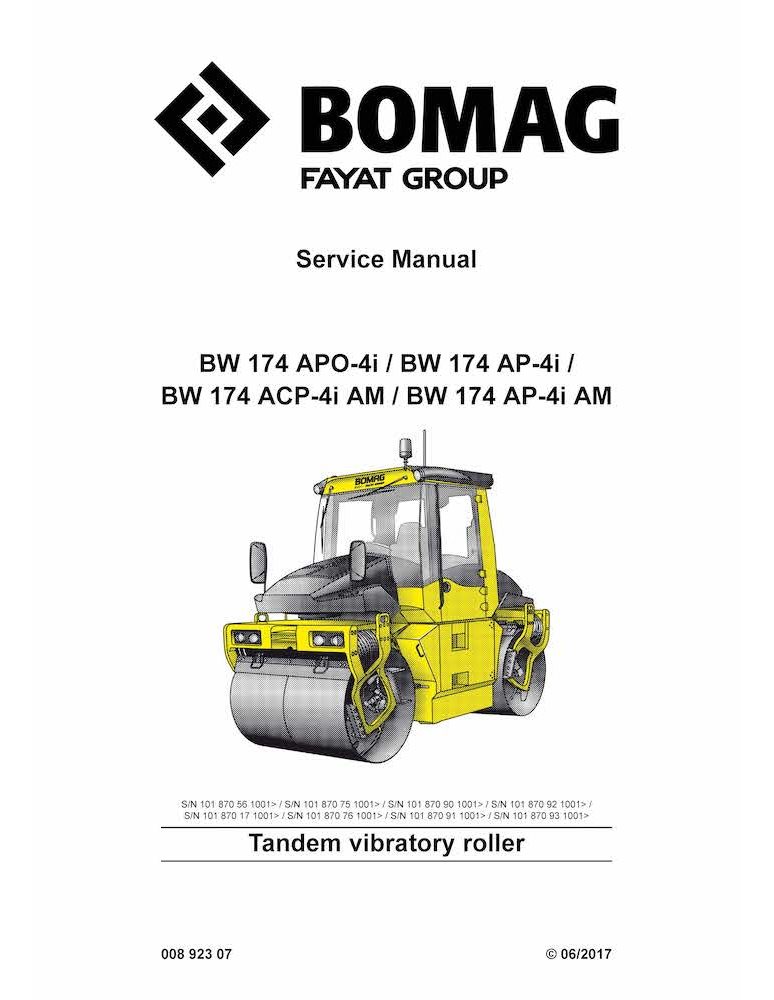
BOMAG BW174 APO-4i vibratory roller pdf service manual
BOMAG-00892307-SM
$34.90
No tax
Format: PDF
Pages: 1676
File size: 68.87 MB
Language: English
Models: BW174 APO-4i; BW174 AP-4i; BW 174 ACP-4i AM; BW 174 AP-4i AM Tandem vibratory rollers
Create an account and join to our cumulative discounts program. Spend at least $29.9 and get 10.00% discount.
Rating:
(0)
Table of Contents for BOMAG-00892307-SM-EN manual
- Table of contents
- 1 General
- 1.1 Introduction
- 1.2 Concerning your safety
- 1.3 Notes on repair
- 1.4 Fuels and lubricants
- 1.5 List of fuels and lubricants, BW 174 AP-4
- 1.6 List of fuels and lubricants, BW 174 APO-4
- 1.7 List of fuels and lubricants, BW 174 AP-4 AM
- 1.8 List of fuels and lubricants, BW 174 ACP-4 AM
- 2 Technical data
- 2.1 BW 174 AP-4
- 2.2 BW 174 APO-4
- 2.3 BW 174 AP-4 AM
- 2.4 BW 174 ACP-4 AM
- 2.5 Additional technical data
- 3 Overview of machine
- 3.1 BOMAG pivot steered tandem rollers
- 3.2 Electric systems
- 3.3 Diesel engine
- 3.4 Hydraulic system
- 3.5 Air conditioning
- 3.6 AP drum
- 3.7 AM and APO drum
- 4 Electric systems
- 4.1 Overview of electric system
- 4.2 Table of fuels and lubricants
- 4.3 Wiring
- 4.4 MESX, A83
- 4.5 CAN BUS overview
- 4.6 Starting the engine with jump leads
- 4.7 Electric steering wheel, A45
- 4.8 Steering angle sensors, B65 & B66
- 4.9 Proximity switches for seat position detection, B178 & B179
- 4.10 Speed sensor, B60
- 4.11 Asphalt temperature sensor, B106
- 4.12 Acceleration transducer, B84 & B85
- 4.13 Electric module, A108
- 4.14 Data collector, A80
- 4.15 Differential pressure switch on hydraulic oil filter (B21 & B22)
- 4.16 Operator's stand
- 4.17 Fuse assignment
- 4.18 Generator
- 4.19 Starter
- 4.20 Telemecanique switch
- 4.21 Deutsch plug, series DT and DTM
- 4.22 Inspection and maintenance work
- 5 Diesel engine
- 5.1 Overview of diesel engine
- 5.2 Features
- 5.3 Cooling system
- 5.4 Intake air heating
- 5.5 Fuel supply
- 5.6 Common-Rail system
- 5.7 Exhaust system
- 5.8 Regeneration of exhaust gas aftertreatment system
- 5.9 Removing and installing the thermostat
- 5.10 Checking the thermostat in disassembled state
- 5.11 Inspection and maintenance work
- 6 Hydraulic system
- 6.1 Overview of hydraulics
- 6.2 Open and closed hydraulic circuit
- 6.3 Hydraulic units
- 6.4 Supply and charge circuit
- 6.5 Travel circuit
- 6.6 Vibration circuit
- 6.7 Steering and crabwalk
- 6.8 Edge cutter, AG6
- 6.9 Edge cutter, AG42
- 6.10 Chip spreader
- 6.11 Test and adjustment points
- 6.12 Tests and adjustments
- 6.13 Flushing and bleeding
- 6.14 Inspection and maintenance work
- 7 ASPHALT MANAGER
- 7.1 Controlled compaction
- 7.2 Description of function
- 7.3 Automatic measuring and controlling
- 7.4 MESX, A83
- 7.5 Block diagrams
- 7.6 Asphalt temperature sensor, B106
- 7.7 Acceleration transducer, B84 & B85
- 7.8 Speed sensor, B60
- 7.9 Hydraulic circuit
- 7.10 Replacing the slewing motor
- 7.11 Potentiometer on slewing motor, B97
- 7.12 Drum
- 7.13 Inspection and maintenance work
- 8 Air conditioning
- 8.1 Overview of air conditioning system
- 8.2 Physical principles
- 8.3 Refrigerant R134a
- 8.4 Compressor oil / refrigeration oil
- 8.5 Working principle of the air conditioning system
- 8.6 Monitoring devices
- 8.7 Description of components
- 8.8 Compressor
- 8.9 Emptying in case of repair
- 8.10 Drying and evacuation
- 8.11 Filling instructions
- 8.12 Steam table for R134a
- 8.13 Inspection and maintenance work
- 9 Drum
- 9.1 Overview, AP drum
- 9.2 Removing the AP drum
- 9.3 Dismantling the AP drum
- 9.4 AD/AP Removing, assembling the exciter unit
- 9.5 Assembling the AP drum
- 9.6 Installing the AP drum
- 9.7 Repair overview AM/APO drum
- 9.8 Removing the AM/APO drum
- 9.9 Dismantling the AM/APO drum
- 9.10 Assembling the AM/APO drum
- 9.11 Installing the AM/APO drum
- 9.12 Inspection and maintenance work AP, AM and ACP AM
- 9.13 Inspection and maintenance work, ACP AM
- 10 Pivot steering
- 10.1 Repair overview oscillating/pivot steering
- 10.2 Removing the oscillating/pivot steering
- 10.3 Installing the oscillating/pivot steering
- 10.4 Repair overview pivot steering
- 10.5 Removing the pivot steering
- 10.6 Installing the pivot steering
- 10.7 Inspection and maintenance work
- 11 Precision spreader
- 11.1 Mounting / removing the precision spreader
- 11.2 Inspection and maintenance work
- 12 Troubleshooting
- 12.1 Preliminary remarks
- 12.2 Emergency procedures
- 12.3 Troubleshooting, electrical systems
- 12.4 Trouble shooting, diesel engine
- 12.5 Trouble shooting, hydraulics
- 12.6 Trouble shooting, air conditioning system
- 13 Special tools
- 13.1 Special tools, electrics
- 13.2 Special tools, hydraulic system
- 13.3 Special tools, drum
- 13.4 List of special tools
- 14 Index
- Appendix
- A Supplier documentation
- B Circuit diagrams
- Document type
- Service manual
- Language
- English
- Machinery type
- vibratory roller

High-Quality PDF Service Manuals for Professional Repair
Our Service Manuals are comprehensive digital products delivered in convenient PDF formats, providing the exact technical data required to maintain, repair, and troubleshoot your equipment. Whether you are a fleet owner or a professional technician, having a dedicated PDF service manual ensures you have instant access to factory-spec information.
What is Included in Our Service Manuals?
Every repair and service manual we provide is structured to offer a professional-grade approach to machinery maintenance. When you download a manual, you gain access to:
-
Detailed Technical Specifications: Precise clearances, capacities, and settings.
-
Step-by-Step Procedures: Guided instructions for assembly, disassembly, and component repair.
-
High-Resolution Diagrams: Clear schematics and exploded views for easy parts identification.
-
Diagnostic Flowcharts: Logic-based troubleshooting to identify faults quickly.
-
Safety & Compliance Guidelines: Essential precautions to ensure safe operation and regulatory compliance.
Why Choose a Digital PDF Service Manual?
A Service Manual is more than just a book; it is an essential tool for maximizing the lifetime of complex machinery. By using our digital service manuals, technicians can accurately diagnose problems, perform precision repairs, and reduce costly downtime.
Unlike paper alternatives, our PDF manuals are searchable, allow for high-quality zooming on intricate diagrams, and can be accessed on any device—from the workshop floor to the field.
Tap to zoom