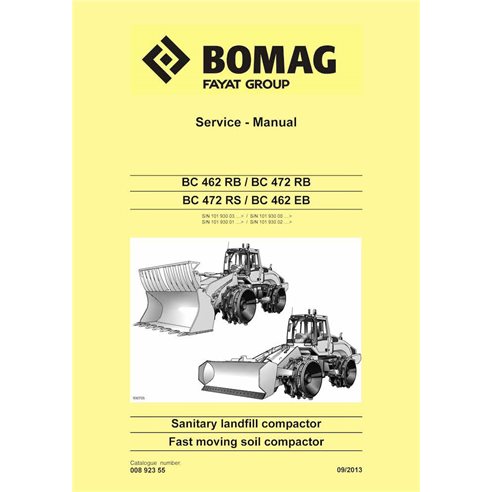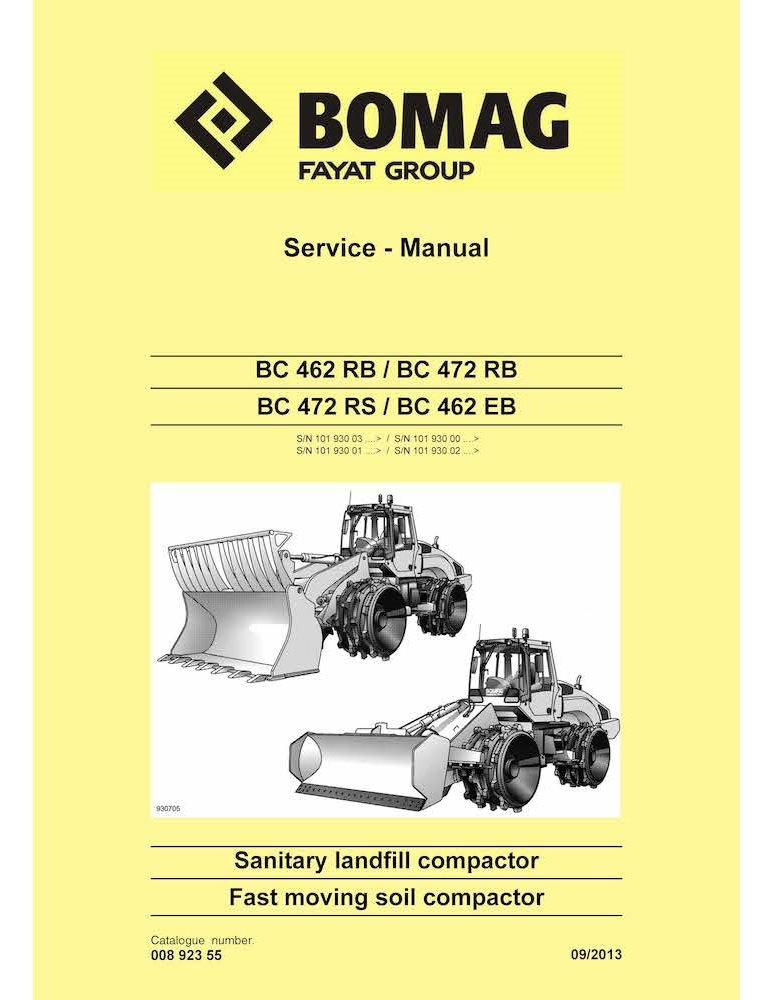
BOMAG BC462, BC472 soil compactor pdf service manual
Format: PDF
Pages: 782
File size: 31.60 MB
Language: English
Models: BC462 RB, BC472 RB Sanitary landfill compactor; BC472 RS, BC462 EB Fast moving soil compactor

Table of Contents for BOMAG-00892355-SM-EN manual
- BC 462 RB / BC 472 RB
- BC 472 RS / BC 462 EB
- S/N 101 930 03 ....> / S/N 101 930 00 ....>
- S/N 101 930 01 ....> / S/N 101 930 02 ....>
- Sanitary landfill compactor
- Fast moving soil compactor
- 1 General
- 1.1 Introduction
- Safety regulations
- Important notes
- General
- Transport work with cranes and lifting tackle
- Precautions and codes of conduct for welding work
- Operation of high-voltage systems
- Old oils
- Hydraulics
- Fuels
- Hot fuels
- Synthetic rubber
- Poisonous substances
- Engine
- Air conditioning system
- Battery
- Special safety regulations
- General repair instructions
- General
- Electrics
- Battery
- Generator
- Starter motor
- Hydraulic system
- Air conditioning system
- Notes on cleanliness for Common Rail engines
- Fuel hoses
- Gaskets and mating surfaces
- Feather keys and keyways
- Ball and roller bearings
- Screws and nuts
- Tightening torques
- 2 Earth compactor - refuse compactor
- Refuse compactor - earth compactor
- Customized for small landfill sites
- The perfect combination of application optimized technology
- Technical data
- Fig. 13
- Fig. 14
- Fig. 15
- Fig. 16
- Noise value
- Vibration value
- 4.1 General notes on maintenance
- Notes on the fuel system
- Notes on the performance of the engine
- Notes on the cooling system
- Notes on the hydraulic system
- Welding work on the refuse compactor
- 4.2 Fuels and lubricants
- Engine oil
- Fuels
- Coolant
- Mineral oil based hydraulic oil
- Bio-degradable hydraulic oil
- Gear oil
- Lubrication grease
- 4.3 Table of fuels and lubricants
- 4.4 Running-in instructions
- 4.5 Maintenance table
- 5 Electrics
- 5.1 Battery service, checking the main battery switch
- Fig. 18
- Checking the main battery switch
- 5.2 Starting the engine with jump leads
- Fig. 20
- 5.3 Main battery switch
- Fig. 21
- 5.4 Hydraulic oil temperature
- Temperature sensor, R04
- 5.5 Pressure switch, hydraulic oil filter
- Differential pressure switches, B21, B22 and B121
- 5.6 Magnetic sensor, hydraulic oil
- Magnetic sensor, B19
- 5.7 Pressure switch for brake
- Pressure switch, B05
- 5.8 Fuel gauge
- Float switch, R03
- Cab electrics
- Fig. 5
- Fig. 6
- Fig. 7
- 5.10 Fuses
- Fig. 8
- Fig. 9
- Fig. 10
- Fig. 11
- Machine related electrics
- 6 Engine electrics
- 6.1 EMR3 system components
- Engine control unit
- EMR-3 system in connection with injection system and electrics
- Sensors TCD 2012/2013
- Sensors TCD 2015
- Shut down the engine.
- 6.2 Pin assignment of engine control EDC16 / EMR3
- 6.3 Rotary speed sensor for camshaft
- Speed sensor, B114
- 6.4 Rotary speed sensor for crankshaft
- Speed sensor, B130
- 6.5 Rail pressure sensor
- Pressure sensor, B93
- Disassembling the pressure sensor
- Installing the rail pressure sensor
- 6.6 Fuel pressure sensor
- Pressure sensor, B145
- 6.7 Fuel control unit
- Control unit, Y137
- 6.8 Injector
- Injectors, Y147, Y148, Y149, Y166, (Y169 and Y170, 6 cylinders engine)
- 6.9 Oil pressure sensor
- Pressure sensor, B88
- 6.10 Sensor for charge air temperature and charge air pressure
- Sensor, B133
- 6.11 EMR coolant temperature sensor
- Temperature sensor, B113
- 6.12 Glow plugs
- R81 to R86
- 6.13 Sensor, water in fuel
- Sensor, B124
- 6.14 Fuel pre-heating
- Fuel pre-heating (option)
- 6.15 Air filter vacuum switch
- Vacuum switch, B03
- 6.16 Float switch in coolant container
- Float switch, B55
- 6.17 Coolant temperature gauge
- Temperature sensor, B152
- 6.18 Charge control light, engine rpm-meter
- Fig. 1 Generator
- Charge control light
- Engine PRM-meter
- 6.19 System faults indicated by flashing code
- Engine protection function of the electric engine controller EMR3
- Deleting the fault log
- 6.20 Diagnose with SERDIA
- SERDIA
- 6.21 Diagnose with CAN-bus
- Fig. 1
- 6.22 Diagnostics interface
- Fig. 1 Control unit in electric wiring box
- Fig. 2 Diagnostics interface in electric wiring box
- Fig. 3 Diagnostics socket
- Fig. 4
- Fig. 5
- Fig. 6
- Flashing code
- EMR3 List of fault codes
- 6.25 Generator
- Three-phase generator
- Charge controller
- Checking the generator
- 6.26 Electric starter
- Directly acting electric starter
- Magnetic switch
- Trouble shooting "Starter"
- Testing and measuring the starter
- Removing and assembling the starter
- 7.1 Diesel engine
- Fig. 1 Deutz diesel engine TCD 2012 and 2013
- 7.2 Engine description TCD 2013, 4 and 6 cylinder, 2 valves
- Fig. 1 Deutz diesel engine TCD 2013 L04 2V, right hand side
- Fig. 2 Deutz diesel engine TCD 2013 L04 V2, left hand side
- Fig. 3 Deutz diesel engine TCD 2013 L06 2V, right hand side
- Fig. 4 Deutz diesel engine TCD 2013 L06 2V, left hand side
- 7.3 Lubrication oil circuit TCD 2012 / 2013
- Fig. 1 Lubrication oil schematic
- 7.4 Coolant circuit TCD 2012 / 2013
- Fig. 1 Coolant circuit
- 7.5 Fuel system TCD 2012 / 2013
- Fig. 1 Fuel circuit
- Fig. 2 Fuel pre-cleaner
- Fig. 3 TCD 2013 Fuel system
- 7.6 Deutz Common Rail (DCR) injection system for TCD 2012 / 2013
- Fig. 1 TCD 2012 and 2013
- Fig. 2 Schematic of the Deutz Common Rail System "DCR"
- Fig. 3 Fuel Control Unit FCU
- Fig. 4 High pressure pump
- Fig. 5 Injector
- Fig. 6 Excerpt from the wiring diagram
- Fig. 7 TCD 2013
- 7.7 Exhaust gas recirculation TCD 2012 / 2013
- Fig. 1 Exhaust/intake valve control TCD 2012 / 2013
- 7.8 Engine problems
- 7.9 Wastegate - charge pressure controller on TCD-engines
- Fig. 1 Exhaust gas turbocharger with Wastegate
- Fig. 2 Exhaust gas turbocharger with Wastegate
- 7.10 Adjust the valve clearance
- Fig. 3
- 7.11 Checking the engine oil level
- Fig. 4
- Fig. 5
- 7.12 Change engine oil and oil filter cartridge
- Fig. 6
- Fig. 7
- Fig. 8
- 7.13 Checking, cleaning the water separator
- Fig. 9
- Fig. 10
- 7.14 Replacing the fuel pre-filter cartridge, bleeding the fuel system
- Change the fuel pre-filter cartridge
- Bleed the fuel system
- 7.15 Replacing the fuel filter cartridges
- Fig. 14
- Fig. 15
- 7.16 Check the coolant level
- Fig. 16
- Fig. 17
- 7.17 Changing the coolant
- Fig. 18
- Fig. 19
- Fig. 20
- 7.18 Checking the anti-freeze concentration and the condition of the coolant
- Fig. 21
- 7.19 Checking the thermostat in disassembled state
- Fig. 1
- Fig. 2
- Fig. 3
- 7.20 Checking ribbed V-belts and compressor V-belts
- Checking condition and tension of ribbed V-belt.
- Checking the condition and tension of the compressor V-belt
- 7.21 Replacing ribbed V-belt and idler pulley
- Fig. 7
- 7.22 Air filter maintenance
- Fig. 8
- Fig. 9
- Fig. 10
- Fig. 11
- Fig. 12
- Fig. 13
- Fig. 14
- Replacing the safety element
- 7.23 Special tools, Deutz engine (TCD 2013 2V)
- 8 Air conditioning system
- 8.1 Physical basics
- Fig. 1
- Fig. 2
- Pressure and boiling point
- 8.2 Refrigerant R134a
- Environmental aspects
- 8.3 Compressor oil / refrigeration oil
- 8.4 Working principle of the air conditioning system
- Fig. 1 Principle sketch of an air conditioning system
- 8.5 Monitoring devices
- Fig. 2 Monitoring chain consisting of:
- 8.6 Description of components
- Compressor
- 8.7 Measuring the compressor oil level
- Fig. 1
- 8.8 Checking the magnetic clutch
- Fig. 1
- Fig. 2 Measuring the air gap
- Cross-section of magnetic clutch
- 8.9 Inspection and maintenance work
- 8.10 Service the air conditioning
- Clean the condenser
- Checking the refrigerant level
- Checking the moisture level of the drying agent
- Checking the condition of the drier/collector unit
- 8.11 Checking ribbed V-belts and compressor V-belts
- Checking condition and tension of ribbed V-belt.
- Checking the condition and tension of the compressor V-belt
- 8.12 Replacing ribbed V-belt and idler pulley
- Fig. 13
- 8.13 Drying and evacuation
- 8.14 Emptying in case of repair
- 8.15 Leak test
- Fig. 1 Electronic leak tester
- Fig. 2 Soap bubble test
- 8.16 Filling instructions
- Fig. 1
- Filling instructions
- 8.17 Trouble shooting in refrigerant circuit, basic principles
- Basic principles
- Overheating
- Supercooling
- 8.18 Trouble shooting, refrigerant circuit diagram
- Fig. 1 Refrigerant circuit diagram
- 8.19 Trouble shooting procedure
- Procedure
- Steam table for R134a
- Module A108
- 9 Central lubrication system
- 9.1 System layout
- Fig. 1 Lubrication system RB machine
- Fig. 2 Lubrication system RS machine
- 9.2 Technical description
- Fig. 3 Monitoring board
- Fig. 4 Control board
- Fig. 5 Push button
- Fig. 6 Operating states
- Fig. 7 Control board
- 9.3 Control
- Control board
- 9.4 Lubrication process
- Main and sub-distributor
- 9.5 Progressive distributor
- Components
- 9.6 Lubrication oil pump
- Components
- 9.7 Checking the central lubrication system, filling up
- Check
- Failure of a lubrication point
- Filling through the grease nipple
- Filling with the hand pump
- 9.8 Faults and causes
- Indication of faults
- 9.9 Fault - Cause - Remedy
- Fig. 38
- Fig. 39 KIT to check central lubrication systems
- 9.10 Failure of central lubrication system (grease emerges from relief valve)
- Pressure OK?
- Grease emerging
- 10.1 Hydraulic circuit
- Open circuit
- Travel pump A4VG110 DA
- Variable displacement pumps, A4VG 85 to 110 DA
- Travel pump A4VG110 HT
- Variable displacement pumps, A4VG 85 to 110 HT
- Steering and working pump
- Axial piston pumps, A10VO/VSO 18 to 100 DFR1
- Axial piston swash plate principle.
- Swash plate principle, pump
- 10.6 Troubleshooting axial piston pumps
- Procedure
- Travel motor
- Description of function
- Flushing valve
- HA2T control
- 10.8 Trouble shooting, variable displacement axial piston motor
- Procedure
- External gear pumps
- 10.10 Travel circuit
- Fig. 34 Schematic travel system, hydraulics
- Travel system
- 10.11 Towing the machine
- Preparing for towing
- Releasing the brake
- After towing
- 10.12 Checking the oil level in the travel gear
- Fig. 52
- 10.13 Steering and working hydraulics
- Fig. 1 Page 7 from the hydraulic diagram
- Steering
- 10.14 Checking the hydraulic oil level
- Fig. 10
- Fig. 11
- 10.15 Replace hydraulic oil filter
- Fig. 12
- Fig. 13
- Fig. 14
- 10.16 Change hydraulic oil and breather filter
- Fig. 15
- Fig. 16
- Cleaning the hydraulic oil tank
- Fill in hydraulic oil.
- Bleeding the hydraulic system
- Disassembling the articulated joint
- Assembling the articulated joint
- 12.1 Replacing the wheel caps
- Required tools/materials:
- 12.2 Adjust scrapers and edge cutter
- Scrapers
- Edge cutter
- 12.3 Checking the cutting plates, replacing the cutting plates if necessary
- Fig. 19
- 13.1 Steering and working pump
- 13.2 Wheel drive
- 13.3 Travel motor
- 14.1 Hydraulic diagram 930,108 40
- 14.2 Wiring diagram 930,107 70
- 14.3 Wiring diagram 5
- 14.4 Wiring diagram 95
- 14.5 Wiring diagram 96
- 14.6 Wiring diagram 182
High-Quality PDF Service Manuals for Professional Repair
Our Service Manuals are comprehensive digital products delivered in convenient PDF formats, providing the exact technical data required to maintain, repair, and troubleshoot your equipment. Whether you are a fleet owner or a professional technician, having a dedicated PDF service manual ensures you have instant access to factory-spec information.
What is Included in Our Service Manuals?
Every repair and service manual we provide is structured to offer a professional-grade approach to machinery maintenance. When you download a manual, you gain access to:
-
Detailed Technical Specifications: Precise clearances, capacities, and settings.
-
Step-by-Step Procedures: Guided instructions for assembly, disassembly, and component repair.
-
High-Resolution Diagrams: Clear schematics and exploded views for easy parts identification.
-
Diagnostic Flowcharts: Logic-based troubleshooting to identify faults quickly.
-
Safety & Compliance Guidelines: Essential precautions to ensure safe operation and regulatory compliance.
Why Choose a Digital PDF Service Manual?
A Service Manual is more than just a book; it is an essential tool for maximizing the lifetime of complex machinery. By using our digital service manuals, technicians can accurately diagnose problems, perform precision repairs, and reduce costly downtime.
Unlike paper alternatives, our PDF manuals are searchable, allow for high-quality zooming on intricate diagrams, and can be accessed on any device—from the workshop floor to the field.