Shopping Cart
There are no more items in your cart
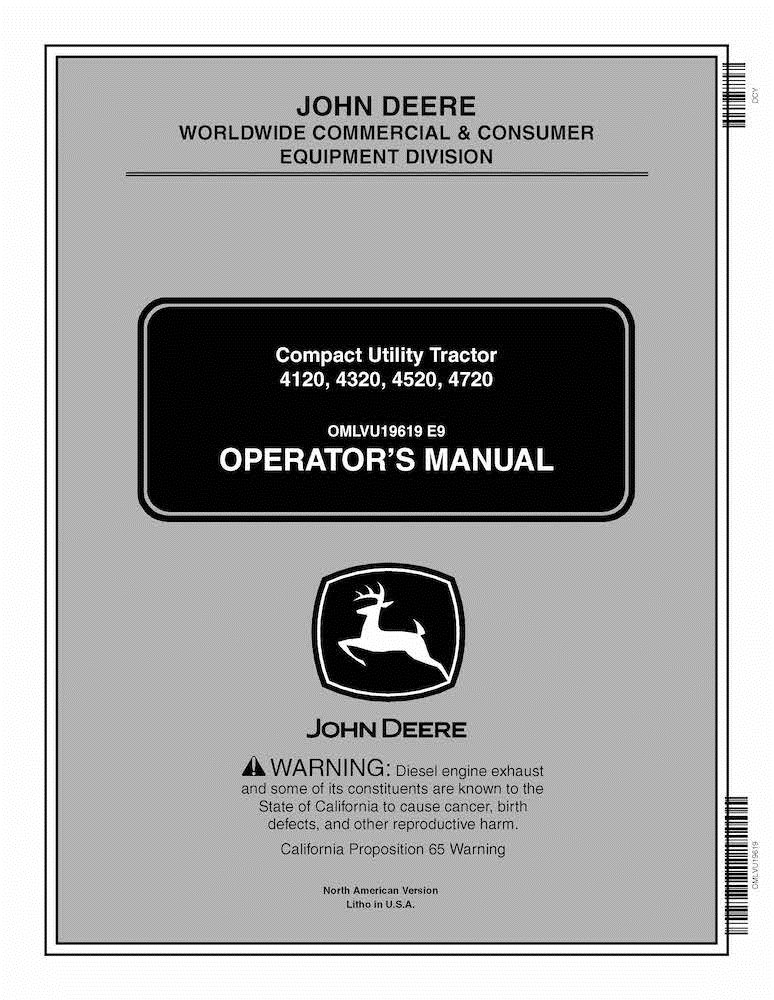
John Deere 4120, 4320, 4520, 4720 SN 610001-810000 NA compact utility tractor operator's manual (OMLVU19619) (OMLVU19619)
OMLVU19619
$8.90
No tax
Format: PDF
Pages: 116
File size: 4.08 MB
Language: English
Models: 4120 (610001-810000), 4320 (620001-810000), 4520 (650001-810000), 4720 (670001-810000) NA
Create an account and join to our cumulative discounts program. Spend at least $29.9 and get 10.00% discount.
Rating:
(0)
Table of Contents for OMLVU19619 manual
- Introduction
- Thank You for Purchasing a John Deere Product
- Using Your Operator's Manual
- Special Messages
- Attachments for Your Machine
- Product Identification
- Record Identification Numbers
- Table of Contents
- Safety Labels
- Safety Label Location
- Understanding The Machine Safety Labels
- DANGER T146195
- DANGER / POISON
- WARNING AVOID CRUSHING LVU10709
- WARNING ROPS R141735
- WARNING ROPS R120124
- WARNING M117557
- WARNING M117554
- CAUTION HOT SURFACE
- CAUTION READ OPERATORS MANUAL LVU10708
- CAUTION READ OPERATORS MANUAL MIU10747
- CAUTION IMatch
- Warning M159705
- Emissions Control System Certification Label
- Safety
- Operator Training Required
- Operating Safely
- Using a Spark Arrestor
- Parking Safely
- Avoid Tipping
- Use Seat Belt Properly
- Keep ROPS Installed Properly
- Keep Riders Off
- Towing Loads Safely
- Stay Clear of Rotating Drivelines
- Checking Wheel Hardware
- Wear Appropriate Clothing
- Driving Safely on Public Roads
- Practice Safe Maintenance
- Avoid High Pressure Fluids
- Prevent Fires
- Tire Safety
- Handling Fuel Safely
- Handling Waste Product and Chemicals
- Operating - Controls
- Operator Station Controls (PowrReverser)
- Operator Station Controls (eHydro No Cab)
- Operator Station Controls (eHydro With Cab)
- Floor Panel Controls
- Air Temperature Controls
- Operating - Machine
- Daily Operating Checklist
- Avoid Damage to Plastic and Painted Surfaces
- Entering and Exiting Machine
- Adjusting Seat (No Cab)
- Adjusting Seat (Tractor With Cab)
- Using Seat Belt
- Using Rear Window
- Using Temperature Controls
- Adjusting Blower Speed
- Adjusting Tilt Steering Wheel
- Using Light Switch
- Using Dome Light
- Using Key Switch
- Using the Instrument Panel
- Using Turn Signal Switch
- Using Windshield Wiper and Washer
- Using Display Mode Switch
- Testing Safety Systems
- Testing Neutral Start Switch (PowrReverser)
- Testing Seat Switch (PowrReverser)
- Testing Rear PTO Knob
- Testing Rear PTO and Seat Switch Interface
- Testing Mid-PTO/Seat Switch Interface
- Testing Rear PTO/Park Brake Interface
- Using Brake Pedals (PowrReverser)
- Using Brake Pedals (eHydro)
- Using Park Brake
- Using Throttle Controls
- Starting the Engine
- Idling the Engine
- Starting a Stalled Engine
- Stopping the Machine
- Operating PowrReverser Transmission
- Driving Machine (PowrReverser)
- Operating eHydro Transmission
- Driving Machine (eHydro)
- Using Cruise Control (eHydro With Standard Cruise Control)
- Using Cruise Control (eHydro With Automotive Cruise Control Option)
- Using SpeedMatch Option (eHydro)
- Using MotionMatch (eHydro)
- Using LoadMatch (eHydro)
- Using eThrottle
- Using Differential Lock
- Using Mechanical Front Wheel Drive (MFWD)
- Using the Power-Take-Off (PTO) Safely
- Using Rear and Mid-PTO (No Cab, Operator on Seat)
- Using Rear and Mid-PTO (Tractor With Cab, Operator on Seat)
- Using Rear PTO (Operator off Seat)
- Using Drawbar Hitch
- Using 3 Point Hitch
- Using Optional iMatch™ Quick-Attach Hitch System
- Connecting Implement Hydraulic Hoses
- Using Dual Selective Control Valve Lever
- Using Dual Selective Control Valve (SCV) Lock Lever
- Using Hydraulic Third Selective Control Valve (SCV)
- Using Diverter Valve
- Using Accessory Electrical Outlet
- Ballasting Machine
- Transporting Machine on Trailer
- Transporting Machine
- Towing Loads
- Using Safety Chain
- Raising and Lowering Roll-Over Protective Structure (ROPS)
- Replacement Parts
- Service Literature
- Parts
- Part Numbers
- Service Intervals
- Servicing Your Machine
- As Needed
- After First 10 Hours
- Every 10 Hours or Daily
- Every 50 Hours
- Every 200 Hours
- Every 400 Hours
- Every 600 Hours
- Yearly
- Every 1200 Hours
- Every Two Years or 2000 Hours
- Service Lubrication
- Grease
- Lubricating 3 Point Hitch
- Service Engine
- Engine Warranty Maintenance Statement
- Avoid Fumes
- Engine Oil
- Checking Engine Speeds
- Checking Engine Oil Level
- Changing Engine Oil and Filter
- Cleaning Dust Unloading Valve
- Servicing Air Filter Element
- Checking Air Filter Hoses
- Checking Air Restriction Indicator Light
- Service Cooling System Safely
- Checking Coolant Level
- Recommended Engine Coolant
- Servicing Cooling System
- Checking Radiator Hoses
- Replacing Fan and Alternator Belt
- Checking Fuel Filter
- Replacing Fuel Filter Element
- Bleeding Fuel System
- Cleaning Grille and Side Screens
- Cleaning Radiator Screen and Fins
- Service Transmission
- Transmission and Hydraulic Oil
- Checking Front Axle Oil Level
- Changing Front Axle Oil
- Adjusting Front Axle Thrust Bolt Torque
- Checking Transmission Oil Level
- Changing Transmission Oil and Hydraulic Suction Oil Filter
- Service Steering & Brakes
- Tractor Without Cab
- Tractor With Cab
- Service Electrical
- Service the Battery Safely
- Checking Battery Electrolyte Level
- Removing and Installing Battery
- Cleaning Battery and Terminals
- Using Booster Battery
- Replacing Headlight Bulb
- Replacing Light Bulbs (Tractor With Cab)
- Replacing Light Bulbs (Tractor Without Cab)
- Replacing Fuses
- Service Miscellaneous
- Using Proper Fuel (Diesel)
- Filling Fuel Tank
- Raising and Lowering Hood
- Servicing Air Conditioner
- Cleaning Cab Air Filter
- Checking Cab Rollover Protection System Installation
- Checking Wheel Bolts and Hardware
- Removing and Installing Wheels
- Checking Tire Pressure
- Selecting Front Tire Rolling Direction
- Changing Wheel Spacing and Tread Width
- Checking and Adjusting Toe-In
- Cleaning Plastic Surfaces
- Cleaning and Repairing Metal Surfaces
- Troubleshooting
- Using Troubleshooting Chart
- Engine
- Electrical System
- Heater and Air Conditioning System
- Machine
- Brakes
- Steering
- Error Codes
- Storage
- Storing Safety
- Preparing Machine for Storage
- Preparing Fuel and Engine For Storage
- Removing Machine From Storage
- Specifications
- Engine
- Electrical System
- Fuel System
- Drive Train
- Hydraulic System
- 3 Point Hitch
- Drawbar Load
- PTO
- Fluid Capacities
- Ground Speeds (Forward and Reverse @ 2600 Engine RPM)
- Front Tires
- Front Tire Inflation Pressures
- Rear Tires
- Rear Tire Inflation Pressures
- Tire Loads
- Dimensions
- Weight
- Recommended Lubricants
- Torque Values - Metric Hardware
- Torque Values - Inch Fastener Hardware
- Warranty
- Product Warranty
- John Deere, Federal And California Emission Control System Warranty (Non-Road Diesel)
- Tire Warranty
- Limited Battery Warranty
- Index
- John Deere Quality Statement
- John Deere Quality
- Service Record
- Record Service Dates
- Language
- English
- Document type
- Operator's manual
- Machinery type
- compact utility tractor
The Importance of Operator’s Manual
An Operator’s Manual is an essential instructional document designed to provide detailed guidance for anyone responsible for the daily operation and care of your machine. This manual serves as the primary resource for understanding the specific capabilities, controls, and technical requirements of your equipment.
The manual begins with a comprehensive overview of the, including vital safety warnings and precautions to ensure the protection of both the operator and the machinery. It provides clear, step-by-step instructions for the initial setup, routine operation, and ongoing maintenance. To ensure clarity, the guide features detailed diagrams and high-quality illustrations that simplify complex components and mechanical workflows.
Beyond basic usage, this PDF Operator’s Manual includes expert troubleshooting tips. By providing solutions for common operational issues, the manual helps users minimize downtime, prevent costly repairs, and maximize the lifespan of their equipment. Choosing a digital PDF format ensures you have instant access to this critical information whenever and wherever it’s needed.
Tap to zoom